
The third quarter provided another reminder that markets rarely move in a straight line, but they often reward investors who remain focused on the bigger picture. Despite continued concerns surrounding interest rates, government borrowing, geopolitical tensions, valuations, and the upcoming election cycle, risk assets generally delivered strong results.
Read on for in-depth discussions of the equity, fixed income, and international markets, as well as what’s going on with data centers and our national grid, and and the dynamics of Opportunity Zone (2.0).
Macroeconomic Overview
Markets climb as higher yields test the outlook
US large-cap stocks continued to benefit from enthusiasm surrounding artificial intelligence (AI) and resilient corporate earnings, while international and emerging-market equities participated to varying degrees. Mid- and small-cap stocks generally lagged their large-cap counterparts, reflecting investors’ continued preference for companies with greater earnings visibility and direct exposure to the AI investment cycle. Meanwhile, bonds delivered more modest returns as investors continued to grapple with stubborn inflation and Treasury yields that remain higher than many anticipated.
One of the more interesting developments today is that the primary risk may no longer be economic weakness. Economic growth, both in the US and globally, has generally proven more resilient than expected. The challenge is that stronger growth comes with costs. Inflation remains sticky, labor markets remain relatively healthy, and bond yields have stayed elevated. While this backdrop supports corporate earnings and economic activity, it also creates headwinds for traditional fixed income investments and raises the risk of occasional disruptions in bond markets. As a result, our asset allocation program remains modestly overweight equities and underweight bonds. While valuations in portions of the equity market are not inexpensive, we continue to believe stocks offer better long-term opportunity than traditional fixed income, where higher-for-longer interest rates may limit fixed income returns.
Importantly, our constructive outlook is not solely a US story. We continue to maintain meaningful exposure to international equities, which represent almost a quarter of our equity allocation. While US markets continue to benefit from leadership tied to AI and related infrastructure spending, many international markets trade at more attractive valuations and offer meaningful diversification benefits. Economic growth outside the US has generally held up better than many expected, and we believe maintaining exposure to opportunities beyond US borders remains prudent, particularly at a time when leadership has become increasingly concentrated.
As we enter the final quarter of the year, our focus is increasingly shifting from economic forecasts to market signals. We continue to watch corporate earnings and guidance closely, looking for evidence that profit growth can support current valuations. We are also monitoring the 10-year Treasury yield, which remains elevated and could pressure both stock valuations and economic activity if it moves meaningfully higher. The US Dollar bears watching as well; a sustained move higher would tighten financial conditions and create headwinds for both risk assets and international markets.
Market breadth has become another important area of focus. While major indexes remain near record highs, leadership has increasingly gravitated toward a relatively small group of companies tied to AI and related infrastructure spending. Healthy bull markets are typically supported by participation across a much wider range of sectors and industries. We continue to expect a constructive year-end environment, but broader participation would increase our confidence that the current advance rests on a solid foundation. We are also monitoring recent weakness in financial stocks. Financial companies sit at the center of the capital markets ecosystem, helping finance both government borrowing and the significant investment spending occurring across the AI economy. Persistent weakness in the group could be an early indication that financial conditions are becoming less supportive.
While no market environment is without risk, we continue to see more evidence of opportunity than danger. Economic growth remains positive, corporate earnings are healthy, and investment in AI continues to create new areas of productivity and innovation. At the same time, we are closely monitoring several market signals, including Treasury yields, the US Dollar, financial stocks, market breadth, and earnings trends. The direction of these indicators will help determine whether the current expansion can continue broadening and whether our constructive outlook remains justified.
Equity Markets
Strong earnings, rising risks: A more selective equity market
US equity markets as measured by the S&P 500 returned 2.3% in the third quarter despite renewed conflict in the Middle East, higher energy prices and rising interest rates. Corporate profit growth remained exceptional with 2026 earnings now expected to come in 32% higher than 2025. Although the largest contributions still came from companies tied to AI infrastructure, most sectors contributed to profit growth. That broadening out of profit growth has been a core tenet of our cautiously optimistic outlook in 2026, and yet the market’s returns remained concentrated among its largest companies. The result is a combination of remarkable growth and modestly elevated valuations that leaves investors balancing strong current fundamentals against a less forgiving outlook for inflation and financing costs going forward.
One of the key drivers of inflation and interest rates this quarter was the collapse of a brief ceasefire in Iran in July. Energy was the S&P 500 sector with the strongest returns in the quarter at 17.2% as investors adjusted to the prospect of tighter supply and higher input costs. Those pressures also prompted the Federal Reserve (Fed) to begin what looks likely to become a series of interest rate increases. The shift marked an important change from the more supportive policy backdrop that had bolstered our optimistic equity outlook early in the year. Higher rates raise the hurdle for investment, reduce the present value of future profits and make bonds more competitive with stocks.
The impact of rising interest rates was readily apparent across financial markets. Stocks and bonds moved together to an unusual degree during the quarter, reflecting their shared sensitivity to changing interest-rate expectations. Rate-sensitive areas such as dividend-paying stocks and smaller companies were particularly vulnerable, while the largest companies proved more resilient. As shown in the chart below, the large tech stocks that dominate the market-cap-weighted S&P 500 supported that widely followed benchmark while considerable weakness developed beneath the surface.
 Source: Bloomberg Finance, L.P.
Leadership within the AI theme also changed. Earlier in the year, the strongest returns came from suppliers of semiconductors, networking equipment, servers and other components needed to build AI systems. In the third quarter, leadership shifted toward the so-called hyperscalers building and operating those systems. One explanation is that a higher cost of capital may slow expansion by companies with weaker balance sheets, reinforcing the competitive advantage of the largest platforms. Still, the hyperscalers are not entirely insulated from tighter financial conditions. Their investment programs increasingly depend on the availability and pricing of debt, leases and other long-term obligations. If funding becomes more expensive or less available, even well-capitalized companies may moderate the pace of spending.
For now, extraordinary earnings-per-share growth supports valuations that remain only slightly above historical norms. The central question is whether that growth can persist as interest rates and credit spreads rise. Higher financing costs could pressure margins, delay investment and expose weaker balance sheets, introducing a new source of risk for equity investors. We remain enthusiastic about the productivity gains and profit opportunities that AI is creating across the economy, but enthusiasm should not be confused with complacency. A period of greater uncertainty and volatility likely lies ahead. In that environment, we continue to focus on long-term investment opportunities built around durable competitive advantages, financial strength, sensible valuations and the ability to adapt to more challenging market conditions.
International Equity
A calm surface masks a violent rotation
Global equity markets delivered modest gains, with the MSCI All Country World Index (MSCI ACWI) rising 1.7% for the quarter. The calm headline, however, masked one of the most violent rotations beneath the surface in years. Three forces drove it. First, disruption in the Strait of Hormuz sent Brent crude up 51% to over $103 per barrel for the quarter, fueling inflation concerns and weighing on global growth. Second, major central banks, including the Fed, the European Central Bank (ECB) and the Bank of Japan (BoJ), all raised interest rates to combat rising inflation, pushing global bond yields sharply higher. Third, mounting concerns over high AI spending triggered a steep selloff in AI-related stocks in July. Leading AI chipmakers later recovered, while memory chip stocks barely rebounded. Against this backdrop, the S&P 500 Index returned 2.3%, outperforming both developed market international equities (MSCI World ex USA Index 1.0%) and emerging market (MSCI Emerging Markets Index -0.2%) in Q3. However, year-to-date, emerging markets (23.7%) remain well ahead of the S&P 500 (12.7%), while developed international markets trail modestly (10.6%).
Despite higher oil prices and rising bond yields, developed market international equities remained resilient, helped by their greater exposure to financials, energy and materials. Country performance, however, diverged significantly. Japan was a standout, with the MSCI Japan gaining 6.1%, lifted by a 3.2% appreciation in the yen and strong gains from banks and insurers as interest rates normalized. Singapore rallied 13.4%, benefiting from an improving economic outlook and strong bank earnings. Europe lagged, with the MSCI Europe Index declining 1.6%. France (-5.4%) remained under pressure from persistent fiscal and political uncertainty, while Germany (0.7%) faced headwinds from higher energy costs and intensifying competition from China.
Emerging markets were even more volatile. South Korea became the epicenter of the July AI selloff and, despite a sharp appreciation of the Korean Won, declined about 10.3% in US Dollar terms. Taiwan was caught in the same July correction but recovered to gain 4.2%, supported by continued strong earnings growth from both chip manufacturers and AI server suppliers. China rebounded by 3.7%, driven by improving manufacturing numbers according to the Purchasing Managers’ Index (PMI), and supportive government policies. India declined 5.5%, hurt by higher oil prices and foreign capital outflows. In contrast, commodity-rich markets proved more resilient, with Latin America gaining roughly 4%.
Looking ahead to the fourth quarter, we remain constructive on international equities, though selectivity matters more now than at any point in this cycle. Emerging markets look particularly attractive, trading at a substantial valuation discount to the S&P 500 while offering higher earnings growth. The key swing factors are likely to be the path of oil prices and the memory chip cycle. A durable easing of disruption in the Strait of Hormuz would likely reverse some of the gains in the energy sector while benefiting consumers, Europe and the de-rated AI supply chain. A prolonged disruption, by contrast, would keep inflation and interest rates elevated. We therefore favor Japan’s rate-normalization beneficiaries and Taiwan’s AI supply chain players. More broadly, we continue to emphasize a quality-focused, bottom-up approach centered on pricing power, strong balance sheets and durable earnings resilience. Source: Bloomberg Finance, L.P.
Fixed Income
The rise in interest rates gets “real”
The third quarter was especially eventful for fixed income markets, as the trend of rising interest rates accelerated. After rising 0.30% in first half of 2026, the 10-Year Treasury yield climbed another 0.82% to yield 5.28%. The 2-Year Treasury yield rose by 0.71%, finishing the quarter at 4.89%. A variety of factors led to the abrupt increase, including the budget deficit and inflationary pressures resulting from resilient consumer demand and the conflict in Iran. Most importantly, rates have risen because the US economy continues to grow at a robust pace, driven by the AI buildout and higher-income consumer spending. Evidence that economic strength is the primary driver of higher interest rates is observable by looking at “real interest rates.” Real interest rates (the nominal rate less inflation expectations) are near their highest levels in 20 years and reflect the market’s view that the US economy can withstand higher borrowing costs. With growth and inflation running hot, the Federal Open Market Committee (FOMC) and Chairman Kevin Warsh increased the Fed Funds rate by 0.25% in the quarter, with additional increases potentially forthcoming in the next year.
Rapidly increasing rates have dramatically altered the available yield in fixed income sectors. At the end of the third quarter, investment-grade and high-yield corporate bond indexes yielded 6.00%1 and 8.49%1 respectively, each of which is over 1.25% higher than at the start of the year. In the municipal bond market, the sell-off pushed the yield of the index to 4.26%2 at quarter end, a level that has not been seen since 2001. This equates to a 7.10% tax-equivalent yield at a 40% marginal tax rate, an attractive proposition for investors. Importantly, credit quality in both markets remains exceedingly strong, and the increase in yield is reflective of market rates rather than fundamental deterioration.
It is worth noting that higher rates may increase risk by tightening credit conditions. Borrowing and investing have been major drivers of economic momentum globally, and there has been strong demand for capital to fund AI infrastructure, energy investments, and defense spending. If credit conditions tighten enough, markets will become increasingly unwilling to provide funding, and a market downturn could follow. Accordingly, we are monitoring credit markets closely for signs of stress, including the appetite for new bond deals and the yields needed to fund them. For the most part, credit markets have been open and available, although investors are clearly distinguishing between stronger and weaker credits. For example, a 10-year Oracle-backed data center bond yields almost 1% more than a Microsoft-backed one, compensating investors for the additional risk. In the high yield market, triple C-rated bonds are showing definitive signs of stress, while BB- and B-rated bonds are not, another example of the differentiation.
Ultimately, credit market function and tone will be a key determinant of risk appetite heading into the fourth quarter. In fixed income portfolios, we continue to recommend diversifying risk across credit-sensitive sectors including securitized bonds, high yield and investment grade corporate bonds, and emerging market debt. We also favor conservative duration positioning and Treasury Inflation Protected Securities (TIPS) as a hedge against inflation pressures. The fixed income environment continues to change quickly, and we are prepared to adjust portfolios accordingly in the coming months.
1 Bloomberg US Corporate Bond and US Corporate High Yield Indices
2 Bloomberg Municipal Bond Inter-Short 1-10 Yr TR Index
 Source: Bloomberg Finance, L.P.
Energy Transition
The grid – hidden capacity in plain sight
As we approach the midterm elections, rising electricity prices are a growing concern for ratepayers and politicians. While it’s easy to blame large tech companies building AI infrastructure, the issue is more nuanced. After nearly 20 years of flat demand, load began rising around 2021 and has been supercharged by AI, with BloombergNEF (BNEF) now forecasting US data center demand to reach 194 gigawatts (GW) by 2035, about one-fifth of US electricity use. The long lull left power equipment supply chains depleted, with transformers and turbines backlogged for years, and 2,290GW of projects sat in US interconnection queues at the end of 2024. Utility business models add friction. Regulated utilities earn returns of around 10% on approved infrastructure, while grid enhancing technologies (GETs), software and sensors that can unlock capacity on existing lines, are generally treated as operating expenses with no return. This misalignment has created an opening for distributed resources, most promisingly demand-side flexibility.
Demand-side flexibility pays electricity users to reduce or shift consumption when the grid is most stressed, or to send stored power back to it. Demand response programs are decades old, but cheaper batteries, smart devices and cloud software now allow millions of small assets, from home batteries to thermostats and electric vehicle chargers, to be coordinated into virtual power plants (VPPs) that grid operators can dispatch. This is capacity for the few hundred most stressed hours of the year, not round-the-clock power, but that matters because the grid is built to meet peak demand. Wood Mackenzie put North American VPP capacity at 37.5GW in 2025, and the Department of Energy (DOE) sees room for 80-160GW by 2030, roughly tripling today’s base.
The bigger change is who is buying. Data center developers are now funding flexibility directly, building on-site batteries, agreeing to curtail during emergencies, or paying VPP providers to free up capacity elsewhere, in exchange for connecting to the grid sooner. Regulators are encouraging the trade, with the Federal Energy Regulatory Commission (FERC) ordering major grid operators in June to offer flexible service options for large loads. Google’s June agreement with Voltus to fund up to 100 megawatts of distributed capacity in PJM, a major regional electric grid operator, is the first signed contract of its kind, and Sunrun, Tesla and Renew Home have since proposed a framework offering up to 16.8GW from 9 million homes. Enrolling households and proving the response will show up when called remains the central challenge.
Taken together, GETs could add an estimated 20-100GW of capacity on existing lines, while VPPs and data center flexibility could add another 65-150GW, ranges that compare favorably with the 90-170GW of peak demand growth implied by the DOE’s projections through 2030. None of this is new energy, but it buys time, providing a bridge to the clean firm power from geothermal and nuclear discussed in our last two letters. The opportunity extends to the software, metering, storage, electrical equipment and financing providers enabling a more decentralized grid. Some of the grid’s most valuable new capacity may already be hiding in plain sight.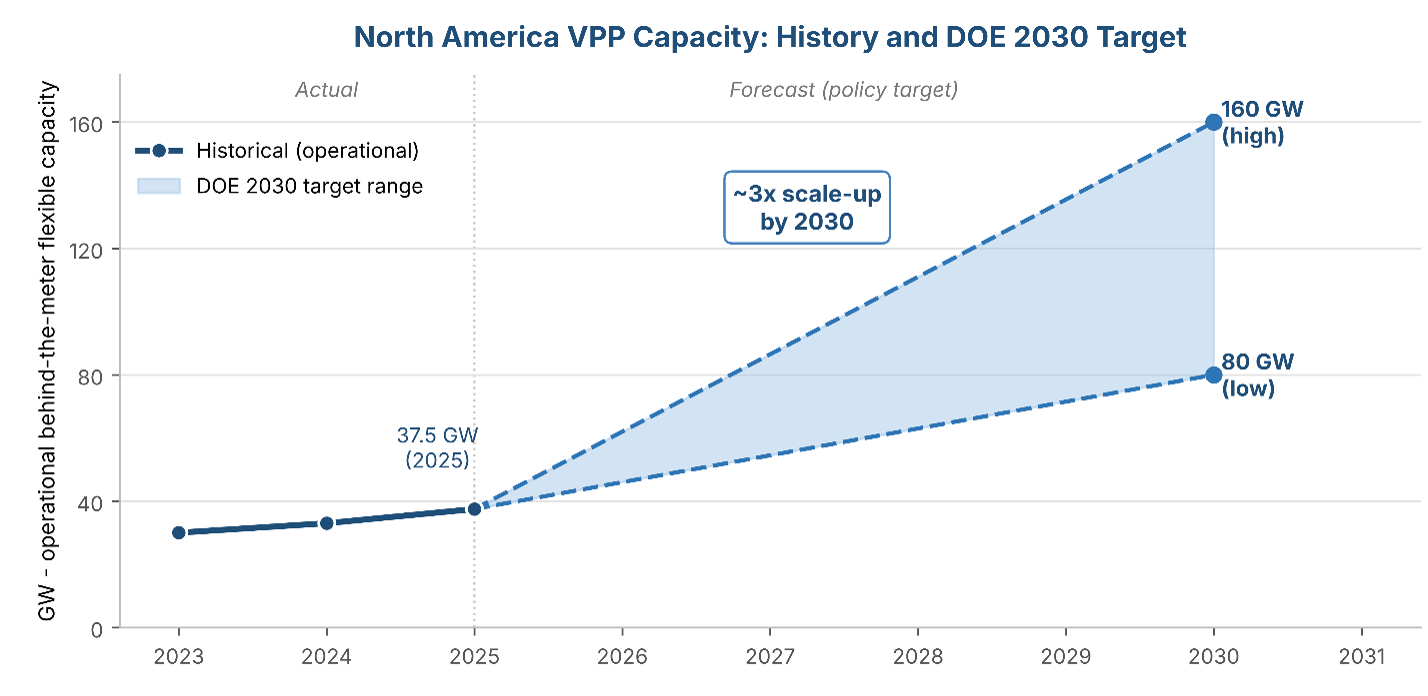 Figure 1: North American VPP capacity reached about 37.5GW in 2025; DOE’s 2030 range of 80-160GW implies roughly a threefold increase. Source: Wood Mackenzie, DOE. Shaded range is a policy target, not a forecast.
Alternative Assets
Qualified opportunity zone 2.0: A new chapter begins
The fourth quarter often brings with it an evaluation of an investor’s tax situation, from harvesting losses to planning around upcoming capital gains. This year, investors can add another tool to the tax-aware toolkit, as a reformed and now permanent version of the Qualified Opportunity Zone program takes effect on January 1, 2027.
The Qualified Opportunity Zone (QOZ) program was created under the Tax Cuts and Jobs Act of 2017 to encourage long-term private investment in economically distressed communities. Under the original program, investors could reinvest eligible capital gains into a QOZ fund and defer taxes on those gains until December 31, 2026. Additionally, certain early investors received a 15% step-up in their basis and any gains within the QOZ fund itself were not taxable so long as the fund was held for at least 10 years. While the program proved to be popular for taxable investors, its usefulness diminished as the fixed 2026 tax-deferral deadline approached. Given this, Congress established what has come to be known as “Qualified Opportunity Zone 2.0” under the One Big Beautiful Bill Act (OBBBA).
The new legislation preserves the core tax benefits of the 2017 legislation but includes some key changes. The most important change is the introduction of a rolling five-year deferral period. Unlike the original QOZ program, where deferred gains became taxable in 2026 regardless of when the investment was made, QOZ 2.0 allows each new investment to receive its own five-year deferral window. Specifically, starting January 1st, an investor in a QOZ fund will receive a 5-year tax deferral on their realized gains. Similar to the original legislation, any gains within the fund will be tax free if held for 10 years. Another notable change under QOZ 2.0 is the creation of rural opportunity zones. Non-rural QOZ investments receive a 10% basis increase, while investments in a qualified rural opportunity zone receive a 30% increase.
Timing also matters. Investors generally have 180 days after realizing an eligible gain to invest into a QOZ fund in order to receive the tax-deferral benefits. As such, suitable investors who experienced a capital gain after July 2026 or plan to realize an investment going forward can potentially take advantage of the new legislation.
Importantly, while the tax benefits are compelling, they should not drive the investment decision on their own. Most QOZ funds are fundamentally long-term, illiquid real estate investments, with returns dependent on factors such as acquisition price, development costs, leverage, execution, financing costs, exit values and broader market conditions. As such, manager selection, diversification, underlying asset quality and overall portfolio fit remain key considerations in our evaluation. In conclusion, we view QOZ 2.0 as a potentially attractive planning tool for certain investors with unrealized gains who are comfortable with a long-term allocation to private real estate.