
By Andrew Wetzlel, CFA®, Managing Director of Sustainable Investing
As we approach the midterm elections, rising costs are front of mind. Higher electricity prices are increasingly an area of concern for ratepayers and politicians. While it’s easy to point fingers at large tech companies developing AI infrastructure, the issue is far more nuanced than just a pickup in demand. An aging grid, supply chain challenges, and the structure of US utility operating models all contribute to a woefully inadequate supply response. Higher prices are starting to drive change that could enable a significant capacity expansion just through efficiency gains, creating a bridge to new low-carbon baseload generation including nuclear and geothermal. In the meantime, innovative approaches to decentralized power that sit behind the meter (BTM) are growing rapidly and may fundamentally change the way electricity is managed in the US.
For most of the last century, the US grid was built around large, centralized power plants, with electricity flowing in one direction over transmission and distribution (T&D) lines to homes and businesses. Reliability depended on balancing supply against a diverse mix of users whose peaks rarely coincided. After decades of expansion, efficiency gains and the offshoring of heavy industry held demand growth roughly flat for nearly 20 years. Demand began picking up around 2021 and has since been supercharged by AI infrastructure, with BloombergNEF (BNEF) now forecasting US data center power demand to reach 194 gigawatts (GW) by 2035, or about one-fifth of US electricity use. With large load demand rising rapidly, the system is struggling to keep up.
That long lull led to retrenchment in power equipment supply chains, which will take years to rebuild. Transformers and turbines have backlogs stretching out many years. At the end of 2024, 2,290GW of projects sat in US interconnection queues, up from 363GW in 2015, and recent projects have taken more than four years to move from request to commercial operation.
There is also a business model challenge. Regulated utilities earn returns of around 10% on new power and T&D infrastructure assets approved by state regulators or the Federal Energy Regulatory Commission (FERC), while the cost of power and operating expenses are passed through to ratepayers. Many grid enhancing technologies (GETs) such as dynamic line ratings and topology optimization are software- and sensor-based, so generally considered operating expenses for utilities. Despite US congestion costs reaching an estimated $17 billion in 2025, nearly double the inflation-adjusted average of the late 2010s, and the potential to unlock significant capacity on existing infrastructure, the market for GETs is diminished relative to a regulatory incentive to build new infrastructure. A proposed federal bill would let utilities keep 10-25% of the savings GETs deliver, but it is not yet law. System inefficiency and incentive misalignment have created an opening for distributed resources, most promisingly demand-side flexibility through BTM assets, storage and virtual power plants (VPPs).
Demand-side flexibility pays electricity users to reduce or shift consumption when the grid is most stressed, or to send stored power back to it. Demand response (DR) programs have paid factories, hospitals and universities to curtail load for more than two decades. What has changed is technology. Cheaper batteries, smart devices and cloud software now allow millions of small assets to be coordinated like a single power plant, and FERC’s 2020 Order 2222 opened wholesale power markets to these aggregations. The primary approaches include:
- DR: Large users cut or shift consumption on request in exchange for payments.
- BTM storage: Batteries at homes, businesses and data centers charge when power is cheap and abundant, and discharge during peaks.
- VPPs: Software aggregates thermostats, batteries, electric vehicle chargers and flexible commercial load into a single resource that grid operators can dispatch.
The GW attached to demand flexibility represent capacity during the few hundred most stressed hours of the year, along with short-duration services that help balance the grid, not round-the-clock baseload power. That still matters, because the grid is built to meet peak demand, not average demand. Shaving peaks means fewer peaking plants, fewer new wires, and more headroom on the existing system.
Scale is still modest, though growing. Wood Mackenzie’s 2025 market report put North American VPP capacity at 37.5GW. The Department of Energy (DOE) sees room for 80-160GW by 2030, enough to serve 10-20% of a US peak load expected to rise from about 760GW in 2025 to 850-930GW. As Figure 1 illustrates, that implies roughly tripling today’s base.
The bigger change is who is buying. For two decades, demand flexibility was sold to utilities as a reliability tool. Now data center developers are funding it directly. A utility cannot connect a new data center until it can count on enough capacity at peak. Operators can close that gap by building batteries behind their own meter, agreeing to curtail during emergencies, or contracting with VPP and DR providers to free up capacity elsewhere on the system. In exchange, they connect sooner. Regulators are starting to encourage the trade. In June, FERC ordered the major regional grid operators to offer flexible service options for large loads, covering roughly 60% of the US data center pipeline, while Texas now requires new loads above 75 megawatts (MW) to be curtailable in emergencies. Meanwhile, capacity prices in PJM, the largest US grid, have risen roughly tenfold in two years, raising the value of every megawatt that can flex at peak.
Google’s June agreement with Voltus is the first signed contract of its kind. Google will fund up to 100MW of distributed capacity in PJM over three years, with Voltus paying homes and businesses to enroll their batteries, thermostats and flexible load. Google’s rationale is telling: with billions of dollars of chips at stake, paying others to flex is often faster and cheaper than idling its own servers. Weeks later, Sunrun, Tesla and Renew Home announced a “capacity-as-a-solution” framework to offer up to 16.8GW from 12 million devices in 9 million homes. The broader pool of untapped assets is far larger. BNEF estimates that up to 325GW of distributed resource capacity will be added to US grids between 2020 and 2030, but only about 89GW is likely to be usable once technical limits and customer behavior are considered. Even less will be under active control. Signing up households, keeping them enrolled and proving to grid operators that the response will show up when called remains the industry’s central challenge.
Taken together, near-term capacity is coming from two directions. On the utility side, GETs such as dynamic line ratings, power flow controls and topology optimization could add an estimated 20-100GW of transfer capacity on existing lines, provided regulators reward utilities for efficiency as well as construction. On the demand side, the DOE’s VPP target implies adding roughly 45-120GW to today’s 37.5GW base by 2030, while BNEF estimates that data center energy storage and managed workloads could contribute another 20-30GW. Combined, these ranges compare favorably with the 90-170GW of peak demand growth implied by the DOE’s projections through 2030. None of this is new energy, but it buys time, providing a bridge to the clean firm power from geothermal and nuclear as discussed in our last two letters. As distributed assets and orchestration scale and costs fall, there is likely a natural path toward large load customers owning those emerging generating assets directly. Today’s grid inefficiency is opening the door to a decentralized, bi-directional system that could be significantly more efficient, lower cost, and eventually, less carbon intensive. The opportunity extends beyond aggregators to the software, metering, storage, electrical equipment and financing providers enabling the shift. Some of the grid’s most valuable new capacity may already be hiding in plain sight.
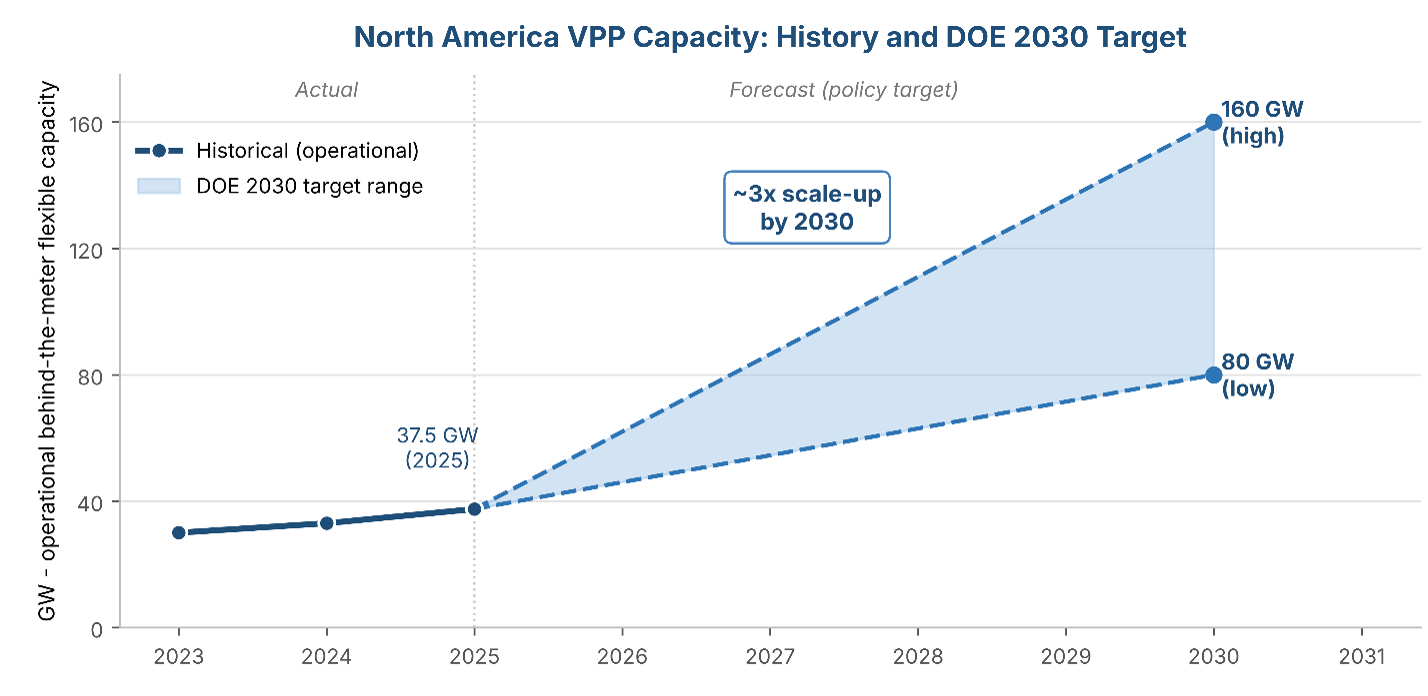 Figure 1: North American VPP capacity reached about 37.5GW in 2025; DOE’s 2030 range of 80-160GW implies roughly a threefold increase.