

By Andrew Wetzlel, CFA®, Managing Director of Sustainable Investing
The tension is palpable. Are large tech companies and their cloud/AI spending compounding climate change, or are they part of the solution? Investors are increasingly asking this question. Picking up from our newsletter last quarter on powering GenAI, this quarter we are digging deeper into corporate climate targets and the mechanisms used to drive change.
Over the last few months, the four large “hyperscalers” (Amazon, Microsoft, Google, and Meta – major cloud & AI leaders) all released environmental sustainability reports covering the most recent fiscal year for each. A review of these environmental reports shows that the goalposts have not changed – all four maintained their commitments to decarbonization. Microsoft, Google, and Meta target “net-zero” CO2e emissions by 2030, while Amazon targets 2040, all four are ahead of the Paris Agreement target of 2050.
These targets cover all company emissions, including “Scope 3,” or value chain emissions. All four hyperscalers note that embodied emissions (from cement, steel, tech hardware, etc.) in new data center construction represent a challenge as they scale cloud and AI-related infrastructure. While aggregate CO2e emissions for this group are up 25% from 2020, the one-year change in 2023 showed a slight decrease, and carbon intensity (emissions divided by revenue) is falling across the group.
Action to date and plans for the future involve a number of factors that can be quite different across these hyperscalers including approaches to procuring clean energy, the use of carbon offsets, plans for direct carbon removal, and approaches to supply chain decarbonization, among others. Both Amazon and Meta have done more to lower emissions recently through lower carbon construction sourcing, and in Amazon’s case, in-sourcing and electrifying their transportation fleet. Both companies reported lower Scope 3 and overall emissions in 2023. Microsoft and Google have both heavily ramped up spending on AI-related infrastructure, driving increased Scope 3 and overall emissions in 2023 compared to 2022. While Amazon and Meta appear to be making more progress, transition plans at Microsoft and Google are more ambitious, involving more direct use of clean energy hourly matching of supply with demand.
The approach to clean energy procurement is important to consider over the coming years. As discussed last quarter, the upward pressure from embodied emissions associated with data center construction should begin to ease as focus turns from building infrastructure to running infrastructure. As data centers are completed and utilized, the carbon profile shifts from embodied resources to long-term power demand for direct operation. The hyperscalers see this growing direct power demand coming and are working to address it.
There are a few ways companies can procure clean energy, with the most common including building on-site generation (solar panels on a roof), buying renewable energy credits (RECs), and entering into power purchase agreements (PPAs). The large hyperscalers all engage in some combination of these approaches. The intensity of data center power demand makes on-site renewable energy generation at best a minor factor, leaving the heavy lifting to RECs and PPAs.
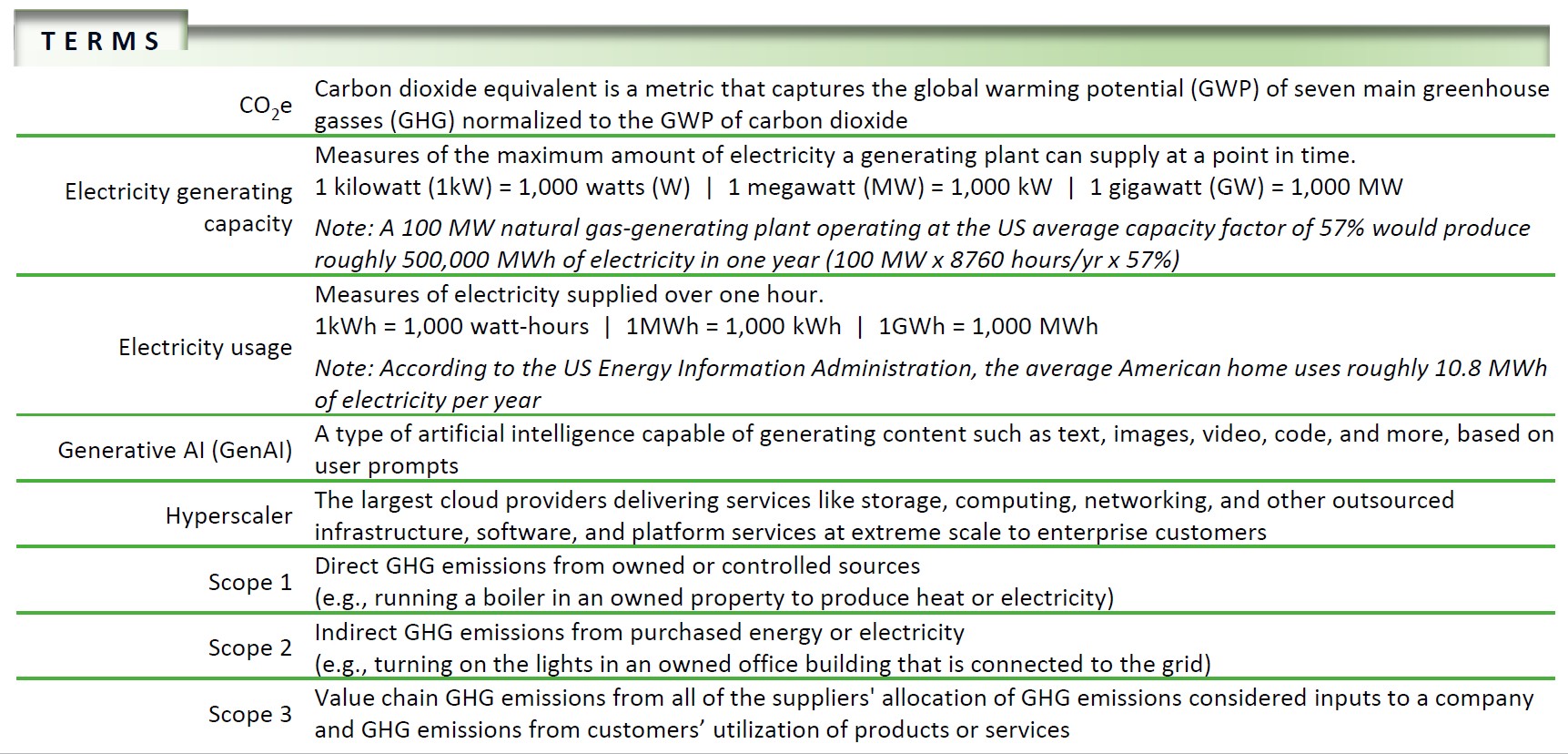
Both RECs and PPAs support clean energy development, though otherwise they are quite different. RECs represent the environmental benefits of 1 megawatt hour (MWh) of renewable energy generation. Corporations that mention the use of RECs in sustainability reports are typically referring to unbundled RECs, meaning the environmental attributes are separated from the physical power generated and delivered. This creates flexibility as companies can buy RECs to match all or part of their annual electricity demand regardless of where or when the power is produced. PPAs, on the other hand, are long-term contracts that are typically 10-20 years, in which a company agrees to buy the power output of a renewable energy project at a predetermined price through the grid, thereby taking power and environmental attributes. This means the renewable asset is a new additional source of power on the grid the company is drawing from. The economic benefits of both RECs and PPAs are meaningful, though PPAs are more direct and long-term in nature, enabling financing of renewable energy projects, commonly referred to as “making a project bankable.” This additionality is increasingly a sought-after attribute by corporations focused on environmental sustainability as it directly finances decarbonization and creates a more tangible tie to the renewable power supply.
The four hyperscalers have made extensive use of RECs to support operational carbon neutrality claims through annual matching. All four also note in their environmental reports that RECs are transitional tools as they move toward direct procurement through PPAs. Actions speak louder than words, and here the actions are significant. As illustrated in the chart below, the four hyperscalers are the largest corporate PPA counterparties, representing about one-third of all PPA deals annually by capacity. Over the last three full years, the hyperscalers represented on average 42% of all PPA deals. Year-to-date 2024, the PPA market is up 33% over the same period in 2023. These PPAs represent clean power the hyperscalers will begin to take delivery of over the next few years, lining up with expected higher levels of direct data center demand.
The market for PPAs should continue to grow as the US and the world more broadly electrify, driving demand and thus pricing in a supply-constrained power market. The fixed price PPAs corporations sign for renewable energy look increasingly attractive as market prices rise. Additionally, project economics are improving as component costs fall with scale and as interest rates normalize.
Recently, the PPA market has experienced a series of large, announced deals across a broad range of clean energy generating assets. These include a deal Amazon struck with Talen Energy in March for a data center with PPA connected to an operating nuclear plant, deals Microsoft made with Brookfield in May and Global Infrastructure Partners in August related to future multi-gigawatt (GW) renewable and storage development, a Google deal in June for a geothermal PPA, and most recently, the Microsoft deal with Constellation Energy to restart one of the Three Mile Island nuclear units. These and other PPAs for renewables plus storage, geothermal, and nuclear represent a path toward more direct clean energy procurement for hyperscalers. Both Microsoft and Google target 24/7 matching of clean energy supply to demand as part of their 2030 net-zero targets. Hourly direct matching goes a step beyond the traditional PPA to ensure the clean energy is not just hitting the grid but doing so where and when the demand occurs. This is additionality and accountability at its best and a clear trend in the corporate clean energy procurement market. We expect to see more direct deals like the selection described above as a growing number of corporations participate based on attractive project economics, power price certainty, and enhanced credibility of net-zero targets. To answer the question posed at the outset, we believe it is increasingly clear that hyperscalers are part of the solution over a multi-year horizon.
